Steam chests and the official drop rates
Every five minutes of play drops one Steam chest, and the official rates are Lv.1 85%, Lv.2 10%, Lv.3 3%, Lv.4 1.5% and Lv.5 0.5%. The chest tab also runs a daily limit with a countdown to reset, so one long idle session hits a ceiling while short regular sessions keep the timer moving.
This is the part of Task Bar Cube that turns an idle game into something that touches your Steam wallet. Every five minutes of play the game gives you a Steam chest, the chest contains Steam inventory items, and those items can be sold on the Steam Community Market. It is also the part of the game the developer documented most precisely, because the drop rates are published on the store page.
The five-minute rule
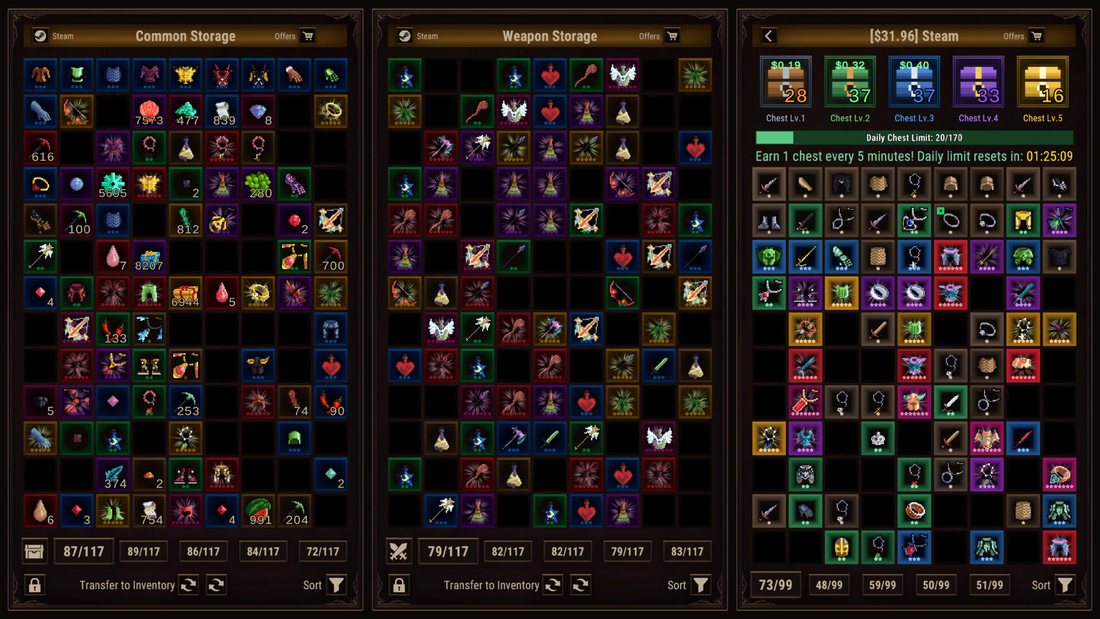
The rule is stated in the game's own chest tab, in a line that reads: earn 1 chest every 5 minutes.
That is a play-time clock, not a wall clock, but it keeps running while the game sits minimised — the same reason the game can be left in the taskbar. It means the drop rate is a function of how long the game is open, so an eight-hour work day with the window open is worth roughly ninety-six chest timers.
The chest tab also runs a daily chest limit with a countdown to the reset. The panel shows the limit as a fraction and a timer, so a marathon session eventually stops paying and short, regular sessions are the pattern the system is built around.
The official drop rates
The store page publishes the chest-level distribution directly. These are the developer's own numbers, unchanged:
| Chest level | Drop rate |
|---|---|
| Lv.1 | 85% |
| Lv.2 | 10% |
| Lv.3 | 3% |
| Lv.4 | 1.5% |
| Lv.5 | 0.5% |
Read it as a shape. Roughly six in seven chests are Lv.1, one in ten is Lv.2, and everything above Lv.2 combined is one chest in twenty. A Lv.5 chest is a one-in-two-hundred event — at one chest per five minutes, one every sixteen hours of play.
The important consequence is the opposite of what it feels like: the system is not designed for Lv.5 drops. It is designed so that a steady stream of Lv.1 and Lv.2 chests carries you, and the high levels are lottery events on top.
What is inside, and what it is worth
Chest contents are Steam inventory items. The store page's phrasing is that every item inside can be sold on the Steam Community Market; the game's own storage screens show the items landing in a Steam storage area before you transfer them into your normal inventory.
| Item property | Where it shows | Why it matters for value |
|---|---|---|
| Rarity | Common → Divine | Sets both the stat ceiling and the market tier |
| Tier | 1 → 7 | Scales the stat roll; tier upgrades are possible |
| Stat lines | Attack Power, Crit Chance, Crit Damage | The real value, above rarity |
| Gem sockets | Set by rarity | An empty slot on a good item is lost value |
| Steam inventory status | Item is a real Steam object | It is tradeable/sellable on the Market |
Two consequences follow. First, an item's market value tracks its rarity and tier, so the rarest chests are also the most valuable finds. Second, because the item is a real Steam object, you have a third option beyond wear-and-sell: feed it into the Steam Collection inside the game for a permanent team bonus. That trade is covered in full on the Steam items page.
Chest levels and your progression
Nothing in the panel suggests chest level gates on your character level; the rates are the rates. What scales with you is what you can use from the chest. Early on, an Epic item is a huge upgrade because you are wearing Commons. Later, an Epic is a duplicate for the Rarity Upgrade ladder.
That shift is worth planning for. In the first few hours, open every chest and equip immediately. Once your gear is Epic and above, the chest becomes a materials delivery: what matters is which duplicates stack toward the next step, not which single item looks best.
The daily limit, and why it exists
The chest tab shows a counter that reads like a fraction with a countdown beside it. Mechanically that is the daily cap: chests stop arriving once you hit the ceiling, and the clock resets later.
The practical reading is simple: the game rewards regular sessions over one heroic marathon. Twenty chest timers in a working day, five days a week, beats a single ten-hour session that hits the cap and then sits there.
Making a chest session count
| Habit | Why |
|---|---|
| Keep the game open while you work | The timer is play time, and the window is designed to be ignored |
| Empty the chest into storage immediately | Storage has page limits; a full page blocks transfers |
| Transfer to inventory before fusing | The fusion and rarity panels work from your inventory, not from Steam storage |
| Check the daily counter before a long session | If you are already near the cap, the session will stop paying |
What the timer actually rewards
Because the clock is play time rather than wall time, the system rewards a game that is simply open. That is a different behaviour from most idle games, which pay out on real-world time whether or not you are running them. Here, closing the game stops the chests, which is why the taskbar window is not a novelty feature — it is the mechanism.
Storage: the thing nobody mentions
The storage screens matter more than they look. Items arrive in Steam storage — the screenshots show separate pages for common items and weapons, each with a capacity like 72/117 — and you have to move them into your regular inventory before the crafting panels can use them.
When a storage page fills up, chests keep arriving but you cannot accept them cleanly. The habit that avoids the whole problem is: every session, transfer everything out of Steam storage into inventory first, then sort. It takes a minute and it prevents the one genuinely annoying failure state in an otherwise frictionless game.
Should you care about the market at all?
Only if you want the second half of this game's value. The Market exists, the items are real, and the sell decision is genuinely interesting for anything above Rare. But the collection side — consuming items for permanent team-wide bonuses — is the part that makes you stronger, and it is available from the first chest.
The honest framing: chests are a trickle of small Steam inventory items with an occasional real find, and the point of the trickle is that both doors are open. Read Steam items: sell or bank before you decide which door is yours.