Cube Upgrade, Prestige and endless levels
Cube Upgrade is the spine: hundreds of nodes, no cap, each with its own level and a 50x buy button so a session's gold goes in one press. Prestige trades that stack for a permanent gold-and-power percentage, and because levels are endless the only real question is which bonus is cheapest right now.
Cube Upgrade is the spine of Task Bar Cube. It is the panel you will open more than any other, it never finishes, and it is the reason the game can be played for months without running out of things to buy. This page explains what it contains, how the buy buttons work, and what Prestige is actually trading away.
What the panel is
The store page describes it in one line: hundreds of upgrades with no cap, plus Prestige. Every node is a repeatable purchase with its own level; buying it raises that level and the price of the next one.
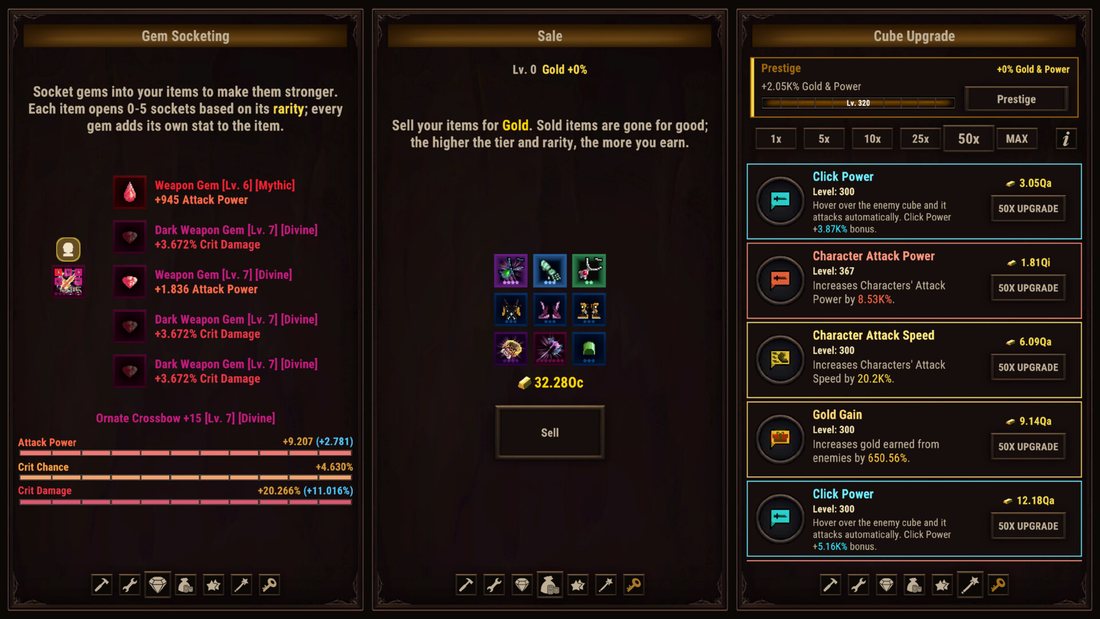
The nodes visible in the official screenshots are the ones you will use most:
| Node | What the panel says it does |
|---|---|
| Character Attack Power | Increases characters' attack power by a percentage |
| Character Attack Speed | Increases characters' attack speed by a percentage |
| Gold Gain | Increases gold earned from enemies |
| Click Power | Hover over the enemy cube and it attacks automatically, with a click-power bonus |
Those four cover the whole early game: damage, speed, income, and the hover layer. Everything else on the panel is either a bigger version of them or a specialist node that becomes worth buying once the four above are expensive.
How buying works
Each node shows three things: its current level, what the current bonus is, and what the next purchase costs. Two controls sit beside it.
- The buy button — one press, one level.
- The 50x button — one press, up to fifty levels, spending whatever that costs.
The 50x button is the single best interface decision in the game, and it changes how you should play. Instead of clicking a hundred times, you open the panel once a session, hit 50x on your cheapest node, and get on with your day. The panel also collapses to a MAX state on a node when you can no longer afford the next purchase, which tells you at a glance where your gold is exhausted.
Costs are written in the game's own short form — thousands, millions, then the letter suffixes — and they climb steeply per level. That steepness is the entire strategy: because every node gets more expensive, the cheapest node is almost always the best value per gold, and the temptation to buy the shiny expensive one is the main way players waste a session.
Why "no cap" changes the maths
Endless levels plus hundreds of uncapped nodes means there is no endgame state where you are "done". Two practical consequences:
- Gold never becomes useless. In a capped game, surplus gold stops mattering. Here, any surplus gold is a purchase waiting to happen, which is why leaving gold unspent at the end of a session is the only real mistake available.
- Progress is a comparison, not a milestone. You are never "at the right level". You are only as strong as your cheapest available upgrade, so the correct question every session is: what is the cheapest thing that still helps?
The percentages on those nodes are large — thousands of percent are normal on a mid-game save — because the enemies scale just as hard and the currencies you spend grow with them.
Prestige: what it costs and what it pays
Prestige is the reset. The panel carries a Prestige control that displays the gold-and-power percentage it will grant, and the store page frames the whole system around it: ACT League exists to give you bonuses that stay even after Prestige, which tells you plainly that Prestige takes something away.
What the game states, and what follows from it:
| Fact | Source |
|---|---|
| Prestige grants a gold and power percentage | The Prestige control on the Cube Upgrade panel |
| Prestige resets the run | Implied by the ACT League carve-out ("bonuses that stay even after Prestige") |
| Some bonuses survive it | ACT League bonuses are explicitly permanent through Prestige |
| Prestige can hit MAX | The control shows a MAX state |
The practical reading: Prestige is a trade of current stack for a permanent multiplier. The percentage it shows is what you get; the levels you lose are what you pay. Whether a given Prestige is worth it depends entirely on how fast you can rebuild — which is why the right time to press it is when your rebuild speed has stalled and the multiplier would carry you past the old ceiling quickly, not the moment the button lights up.
Two habits that make Prestige safe:
- Do the ACT League first. Its bonuses are the ones that come with you, so clearing a rival boss before a reset is worth more than any node you could buy with the same gold.
- Bank the collection. Steam Collection bonuses are permanent and stack with Cube Upgrade and Talent Tree percentages, so they too survive whatever Prestige takes.
Where the surrounding systems fit
Cube Upgrade does not stand alone. Four other systems feed it or multiply it:
| System | Relationship to Cube Upgrade |
|---|---|
| Talent Tree | Adds percentage bonuses that stack with upgrade percentages |
| Steam Collection | Adds team-wide percentages that stack the same way |
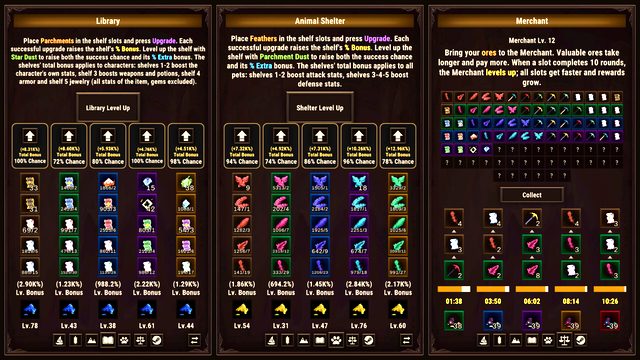
| Library / Animal Shelter shelves | Shelf bonuses apply to characters or pets on top of everything |
| Gear and gems | Flat stat lines that the percentages then multiply |
If your gear is the weak link, another 5% attack power is 5% of a small number. Raise the base first, then the percentages.
A session routine that keeps the panel honest
- Open Cube Upgrade and sort by cost. Cheapest first is the default correct order.
- Dump gold into the cheapest helpful node with 50x, repeatedly, until MAX.
- Check whether the next-cheapest purchase is in a different stat family. If damage is already comfortable, buy Gold Gain instead.
- Spend down to near zero. Gold in the bank does nothing.
- Only Prestige when rebuilding would be fast — that is, when your gear and collection are carrying the early levels anyway.
- Before you Prestige, clear what survives. ACT League bosses, collection levels and shelf upgrades are the things you keep.
The one number to watch
Character sheet DPS. Not the node percentages, not the gold total, not the rarity of your gear — DPS, because it is the only figure that includes everything at once. If a 50x purchase moves DPS by less than a percent, you have found a node that has outlived its usefulness, and the gold belongs somewhere else.
That is the whole skill of this panel: buy the cheapest thing that moves DPS, and never stop buying.